Tapping the Timber: Inside the Quiet Pilgrimage of American Instrument Makers to Japan's Forests
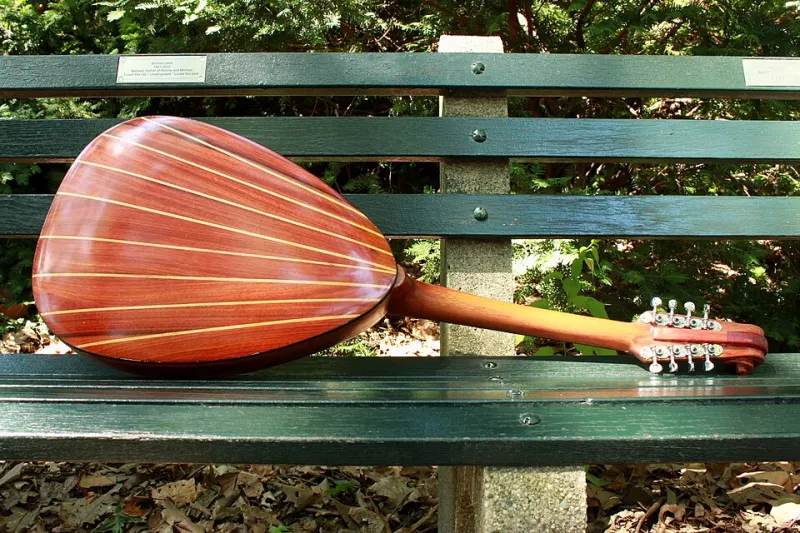
Photo: Joseph Brent, CC BY-SA 2.0, via Wikimedia Commons
In a warehouse outside Nagano, a violin maker from Oregon raises a knuckle and raps the edge of a spruce plank the way one might knock on a stranger's door. The wood answers — a clear, high ping that seems to hang in the cold air a moment longer than it should. She nods, moves to the next board, knocks again. This one is duller, tighter. She sets it aside without ceremony.
For most of the American instrument trade, wood arrives by the pallet, graded by machine, kiln-dried to uniformity. For a small but growing circle of luthiers, that is no longer enough. They are flying to Japan — to the sawmills of Hokkaido and the misted valleys of Kiso — to select spruce the way Japanese craftsmen have for generations: by ear, by season, by hand.
The Knock That Decides Everything
The practice has no marketing name and no certification. In Japanese workshops it is often simply called tataki — the tapping. A seasoned builder strikes the soundboard stock and listens for resonance, density, and what one Kiso sawyer described to visitors as the wood's "willingness." A board that rings freely is said to have opened up; a board that thuds is still asleep.
Western science can partially explain this. Tap tones correlate with stiffness-to-weight ratio, the holy grail of soundboard material. But the Japanese approach resists reduction to a single metric. Timing matters. Trees felled in winter, when sap is low, are preferred. Boards are aged in unheated sheds for years — sometimes decades — before they are considered ready to be heard at all.
"In America we ask what the wood measures," says a guitar builder from Vermont who made his third pilgrimage to Hokkaido last February. "Here they ask what the wood is ready to become. It sounds like poetry until you watch a master reject a $400 blank because it hasn't finished resting. Then it sounds like discipline."
Why the Pilgrimage?
The answer lies partly in supply. The tight-grained alpine spruce prized by instrument makers is increasingly scarce, and the best European stocks are spoken for years in advance. Japanese mills, drawing from Hokkaido's Sakhalin spruce and the historic forests of the Kiso Valley, offer not only exceptional material but a relationship to it — provenance, patience, and a chain of custody measured in generations rather than purchase orders.
But the American visitors, many of whom first arrived for wood and returned for the philosophy, describe something deeper. The Japanese sawyer does not merely sell a board; he presides over its passage. He will ask what the instrument is for, who will play it, whether it must carry a concert hall or a living room. The wood is matched to the music.
That conversation is nearly impossible to have over a wholesale catalog. It requires standing in a cold shed, knocking on timber, and waiting for an answer.
Slowness as a Standard
What strikes most visitors is not the selection itself but the refusal to hurry it. A board may sit in storage for fifteen years before it is offered for sale. The sawyer speaks of mawari-dokoro — the places where things take their time — without embarrassment. In an American market governed by quarterly turns, this is almost unintelligible. And yet the results, in instruments of startling warmth and projection, are not.
Some of the visiting luthiers have begun to adapt the practice at home: air-drying their own stock, tapping every blank before the first cut, learning the sound of their material well enough to be governed by it. Others simply keep making the trip, building the journey into their craft the way a violinist builds scales into the day.
"I used to think choosing wood was the beginning of the work," the Vermont builder reflects. "Now I understand it is most of the work. Everything after is just revealing what you heard in that first knock."
What the Trees Teach
There is a quiet irony in American makers traveling across the Pacific to learn an older way of listening. The method predates recordings, standardized grading, and the entire apparatus of modern supply. It assumes that quality cannot be fully specified, only recognized — and that recognition is a skill, cultivated over years, that no machine has yet replicated.
For the craftsmen making the journey, the lesson extends beyond soundboards. To select slowly is to respect the material's own timeline. To knock and wait is to admit that the wood, not the builder, holds the final word.
In the shed outside Nagano, the Oregon violin maker finds a board that rings like struck glass. She marks it with chalk, and the sawyer smiles — not because a sale is made, but because, as he puts it, "the tree has found its work." On the other side of the world, an instrument that does not yet exist has just taken its first breath.