A Face Carved to Vanish: The Noh Mask That Ended Up Above a Manhattan Fireplace
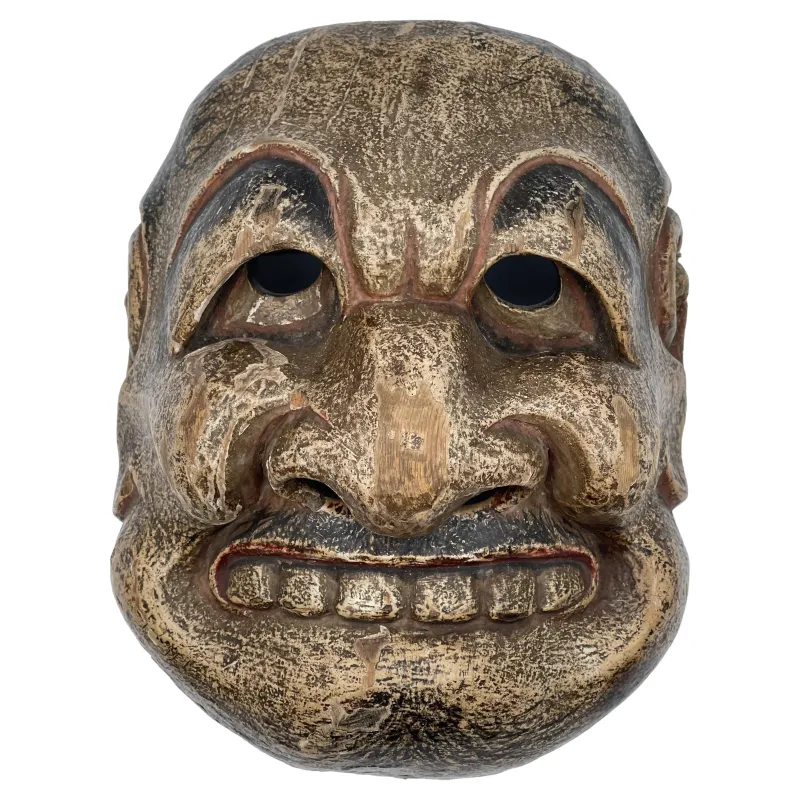
Photo: antique Japanese Noh mask carved wood traditional theater, via a.1stdibscdn.com
The mask is small — barely seven inches tall — and would be unremarkable to an untrained eye. Painted cypress wood, a faint smile, eyes that seem to shift depending on where you stand. For two centuries, it lived in a Kyoto storehouse and appeared perhaps a dozen times a year, worn by an actor who trained his whole life for the privilege. Today it hangs above a fireplace on Manhattan's Upper East Side, insured for more than a Park Avenue co-op pays in annual maintenance.
How faces made to be feared became objects to be coveted is a story about Japan, but also — perhaps more urgently — about us.
Built for the Dark
A Noh mask was never designed to be looked at directly. It was designed to be looked at through — candlelight and, later, firelight catching the lacquered surface at oblique angles, giving the carved expression its famous ambiguity. The ko-omote, the young woman's face, reads as serene from one angle and sorrowful from another. The hannya demon mask, all horns and metallic glare, transforms under a raised chin into something genuinely unsettling.
The carvers who made these objects were not sculptors in the Western sense. They were craftsmen serving a ritual, and the finest among them signed their work with a single character or not at all. The mask's purpose was transformation: the moment an actor held it before his face and became someone else. Between performances, it lived wrapped in white cloth, sometimes in its own dedicated box, treated less like an object than a presence.
Which raises an uncomfortable question for the growing roster of American collectors: can an object built for that life survive this one?
The New Market
Auction houses in New York and Los Angeles have seen a quiet but unmistakable climb. Edo-period masks in strong condition, particularly those attributable to named carving lineages like the Deme or Ichiyu schools, now routinely clear six figures. Dealers describe a buyer profile that would have been unthinkable twenty years ago: tech founders, film production designers, collectors who began with ukiyo-e prints and wanted something with more weight.
Part of the appeal is scarcity dressed as practicality. A Noh mask is compact, condition-stable compared to textiles or scrolls, and photogenic in a way that suits contemporary interiors. Interior designers on both coasts have begun specifying them the way they once specified African masks or Korean moon jars — a single object with enough presence to anchor a room.
The man who owns the Manhattan ko-omote — a media executive who asked not to be named — is candid about the tension. "I know what it was for," he says. "Some nights I look at it and feel like I'm doing something wrong. Other nights I think, if it had stayed in the storehouse, nobody would be looking at it at all."
It is a fair defense. Preservation has always depended on someone caring enough to pay.
What the Face Remembers
Scholars of Japanese theater are more ambivalent. A mask, they note, is not a painting; it is equipment. Its meaning lives in use — in the actor's breath fogging the inside, in the particular tilt of a head that turns grief into laughter. Remove the performance and you keep the artifact but lose the argument it was made to make.
There is also the matter of provenance, which the market is only beginning to grapple with. Many masks left Japan during the turbulent decades of the early twentieth century, and not all of those departures were clean. Reputable dealers now insist on documented export records; buyers increasingly ask. The mask on Fifth Avenue traveled through a Seattle collection assembled in the 1960s, its paperwork intact — a fact its owner considers part of the purchase, not an accessory to it.
Two Ways of Keeping
There is a middle path, and some collectors are finding it. A handful of American buyers have begun lending their masks to university theaters and museums for supervised handling sessions, letting drama students study the weight and sightlines of a genuine Edo-period face. Others commission contemporary carvers — several of whom now sell to Western clients directly — keeping the lineage alive rather than merely embalming it.
The Kyoto carver Mitsuya Nakamura, whose family has made masks for four generations, puts it plainly: "A mask in a glass case is a corpse. A mask worn is alive. But a mask that makes someone in America curious about Noh — that is not nothing."
Perhaps that is the honest answer. The face above the fireplace will never again transform an actor in candlelight. But it may catch the eye of a dinner guest who goes home and searches for a performance, or a carver, or a history. Objects made to be feared can survive becoming décor — provided someone, somewhere, remembers what the fear was for.