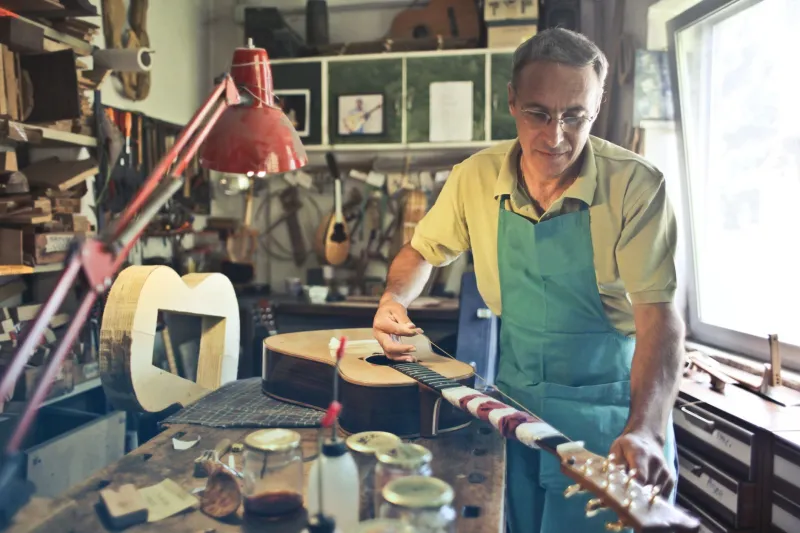
Steeped in Disagreement: A Brooklyn Studio's Year of the Two-Hour Tea Gathering
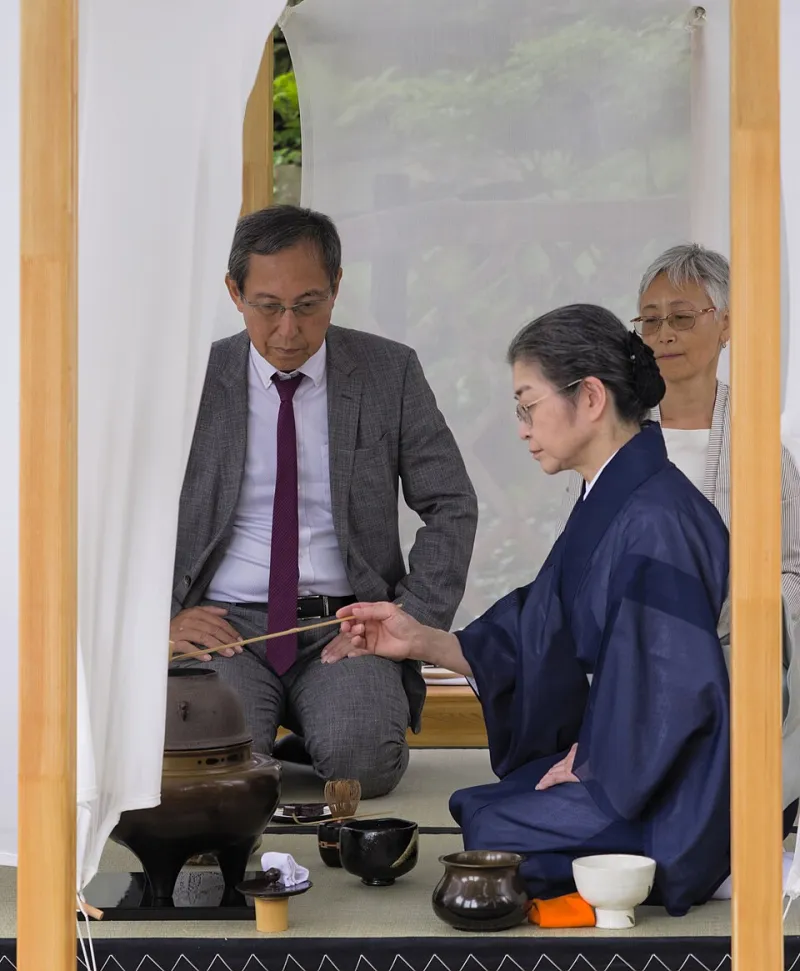
Photo: D-Kuru, CC BY-SA 4.0, via Wikimedia Commons
The first tea gathering at Meridian Type & Co. lasted four minutes.
It was supposed to last two hours. Maya Okonkwo, the studio's creative director, had spent the previous summer in Kyoto, where she sat — stiffly, she admits — through a full temae in a tea room no larger than a Brooklyn parking space. She returned to New York convinced that her eleven-person type foundry had lost something essential: the capacity to sit together without producing anything.
So she did what American studios do. She imported the solution.
The Stand-Up Dies
For three years, Meridian had run the standard ritual of the American creative economy: the daily stand-up. Fifteen minutes, everyone standing, everyone reporting. Okonkwo came to see it as theater — a performance of productivity in which nobody listened and everybody waited to speak.
Her replacement was ambitious. Once a week, the studio would gather in its back room around a cast-iron kettle, and the morning would simply... happen. No agendas. No status updates. Just the sequence of the tea ceremony: the cleaning of the utensils, the folding of the silk cloth, the precise, unhurried preparation of matcha, and the quiet consumption of it by everyone in turn.
The first week, the gathering lasted four minutes. People made the tea, drank it, and fled to their desks. Okonkwo had imported the objects of the ritual without its most radical component: time.
What Chanoyu Actually Asks
The Japanese tea ceremony — chanoyu, or the way of tea — is often reduced in the American imagination to aesthetics: the rough pottery, the seasonal flower, the wabi-sabi sensibility that has decorated a thousand coffee-table books. But the ceremony's founder, Sen no Rikyū, built the practice on four principles: harmony, respect, purity, and tranquility. And crucially, the ceremony is not about the tea. It is about the room agreeing to a shared tempo.
In a traditional gathering, the host may spend hours preparing, and guests are instructed to arrive with what the tradition calls a "rare frame of mind" — a willingness to leave the ordinary world at the door. The two hours are not overhead. They are the point.
Okonkwo's mistake, she now says, was treating the ceremony as a productivity hack with better props.
The Year of Friction
By the second month, having mandated a full two-hour gathering every Tuesday, the studio was at war.
The objections fell into predictable camps. The younger designers resented the time — two hours was a third of a workday spent not designing. The senior staff resented the theater — one typographer, a lapsed Catholic, called it "communion without the theology." And nearly everyone bristled at what they perceived as cultural flattening: the sense that a living tradition had been lifted from its context and stapled to a Tuesday calendar in Gowanus.
The sharpest critic was Dana Reyes, the studio's operations lead, who had family in Nagano and had grown up around her grandmother's practice of tea. "You can't schedule stillness," she told Okonkwo in a meeting that, ironically, ran long. "My grandmother's tea was slow because her whole life was slow. You're bolting slowness onto a life that isn't."
What Changed
The turning point was not philosophical but structural. Okonkwo stopped hosting. Instead, the role of host rotated weekly, and each host was permitted to adapt the gathering — not the sequence of the ceremony, which stayed fixed, but the room, the sweet, the conversation, or the silence.
Reyes hosted the following week. She said almost nothing, served a simple wagashi from a shop in the East Village, and let the kettle do the talking. It was, several staff members later agreed, the first gathering that felt honest.
By spring, something had shifted that none of them could quite name. The Tuesday gathering had become the studio's most protected hour — defended, tellingly, not by Okonkwo but by the staff. Deadlines bent around it. A client who demanded a Tuesday morning call was told, politely, that the studio was unavailable until noon.
More surprising was what happened to the work. Okonkwo noticed that the studio's revisions had slowed — not in output, but in reflex. Designers sat with problems longer before reaching for a fix. "The tea didn't teach them patience," she says. "It gave them one place where patience was the norm, and the norm started leaking."
Can You Import a Practice?
A year in, Okonkwo's conclusion is appropriately un-American: no, slowness cannot be imported. It can only be earned, and only slowly.
What can be imported is the container — the kettle, the sequence, the protected hour. But the substance, the shared tempo that Rikyū built his practice around, has to be grown in place, out of the specific people in the specific room. The ceremony gave Meridian a shape. The staff had to give it a life.
There is a lesson here for the small industry of American studios borrowing Japanese concepts — ma, kodawari, ikigai — and applying them like software patches. The words travel easily. The practices they name were never designed to travel, because they were never practices at all. They were the visible surface of an entire way of inhabiting time.
Meridian still gathers on Tuesdays. The gatherings now run two hours, sometimes more, and nobody watches the clock. Okonkwo keeps a scroll in the tea room — a gift from a Kyoto potter — inscribed with a line from Rikyū: "Tea is nothing but this: first you make the water boil, then infuse the tea, then you drink it properly. That is all you need to know."
It took her a year to understand what "properly" meant. It meant: on the room's own time.