One Square, No Waste: The Boston Engineer Who Learned to Build by Unlearning
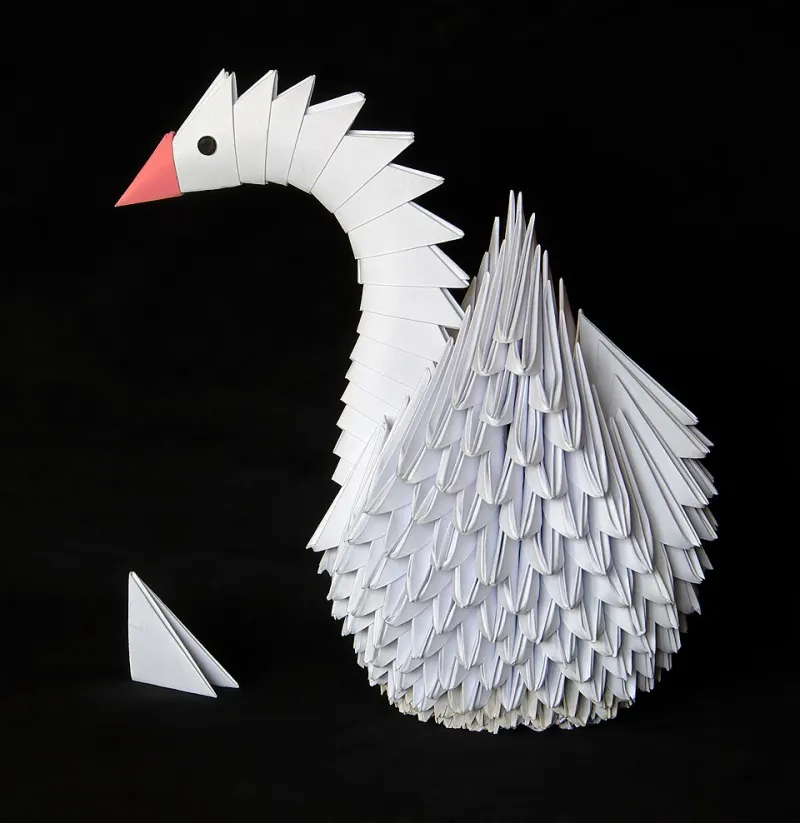
Photo: Jacek Halicki, CC BY 3.0, via Wikimedia Commons
The Problem With Adding
Maya Ellison has spent fifteen years designing things that unfold. As a structural engineer in Boston, she has worked on pedestrian bridges that ship flat and stand tall, and on solar arrays that must squeeze into a rocket fairing no wider than a school bus. By her own account, her early solutions all shared one flaw: they solved problems by adding. More hinges, more joints, more fasteners, more failure points.
"American engineering culture rewards complexity," she says. "If your drawing looks impressive, people assume it works. Nobody ever congratulated me for removing a part."
That assumption began to collapse in 2019, when a colleague handed her a monograph on origami mathematics — the same body of work that inspired deployable space structures at agencies she had long admired from afar. She read it twice, folded through the night, and booked a flight to Tokyo.
Studying Under the Masters of Restraint
Ellison's month in Tokyo was not a conference. It was an apprenticeship of sorts, split between a folding circle in Sugamo and the archive of a paper-folding association whose senior members have spent decades refining a single form. Her teachers, most in their seventies, did not speak English and did not need to. They corrected her creases by hand.
What struck her first was the material. Washi, the Japanese paper she had dismissed as craft-store nostalgia, behaved nothing like the copy paper she used at her kitchen table. Its long fibers distribute tension along the grain; a diagonal fold against that grain fails differently than one made with it. "I had been treating paper as a cartoon of a material," she says. "They treated it as a structural member. Because it is one."
Her second lesson took longer. Her Tokyo mentors worked almost exclusively from a single uncut square — a discipline that struck her, an engineer accustomed to cutting, splicing, and laminating, as almost punitive. Then she understood: the uncut square is not a restriction on the design. It is the design. Every crease must negotiate with every other crease before the first fold is made. In her field, the equivalent discipline is called a compatible mechanism — a structure that deploys as one continuous motion rather than a sequence of bolted compromises.
From Crane to Causeway
Back in Boston, Ellison rebuilt her approach from the crease pattern up. Her current deployable bridge prototype — developed with a small Cambridge firm and currently in testing with a state infrastructure office — folds from a flat bundle the size of a surfboard into a twelve-foot walkable span. It uses a single degree of freedom: pull one cable, and the entire structure blooms into place, the way a morning glory opens. No sequential assembly. No parts left on the garage floor.
The same logic now informs her work on satellite solar panels, where a single folded membrane must unfurl reliably after the violence of launch. The origami-derived patterns she favors — Miura-ori variants and their cousins — pack flat, deploy with minimal actuation, and, crucially, fail loudly: a bad crease reveals itself in testing rather than in orbit.
What She Had to Unlearn
Ellison is careful not to over-romanticize. Her Tokyo teachers were not thinking about load paths or aerospace contracts; they were thinking about a square of paper and what it owed them. The translation happened in her, not in the paper.
But the philosophical shift has proven durable. Where she once optimized by addition, she now optimizes by subtraction — asking of every joint, as her Tokyo mentors implicitly asked of every fold, whether it earns its place in a single, indivisible whole.
"The square doesn't complain, and it doesn't negotiate," she says. "You either understand it or you don't. I flew nine thousand miles to learn that the hardest engineering skill is accepting a rule you can't change — and then designing something beautiful inside it."
Her folding circle in Sugamo, she reports, has seen the bridge photographs. Their verdict, relayed through a translator: the creases could be sharper.
She is, she says, still working on that.