One Cushion, One Fan: What Tokyo's Storytellers Taught a Chicago Comic About Silence
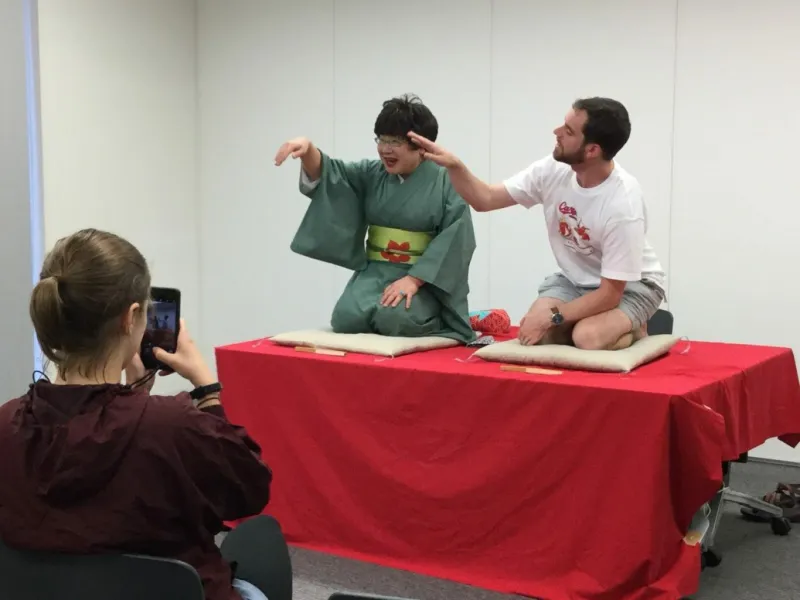
Photo: rakugo performer kneeling on cushion telling story with fan on traditional Japanese stage, via www.samuraitours.com
The performer enters in a kimono, kneels on a cushion, and bows. There is no microphone check, no stool, no glass of water on a side table. In his right hand, a folded fan. In his left, nothing at all. For the next forty minutes, he will play every role in his story — a penniless apprentice, a furious lord, a talking cat — using nothing but his voice, his posture, and that fan, which will become a pipe, an umbrella, and a sword before the evening is through.
This is rakugo, Japan's art of the long fall. And increasingly, it is American comedians — the kind who measure success in laughs-per-minute — who are flying to Tokyo to find out why it works.
The Craft Behind the Punchline
Rakugo is often described as a 400-year-old form of solo storytelling, but the description undersells its rigor. A performer, the rakugoka, sits seiza-style on a small cushion and delivers an extended comic narrative that builds to a final punchline called the ochi, or drop. Everything before the ochi is construction. Every anecdote, every repetition, every seemingly idle remark exists to make the drop land harder.
American stand-up has its own theories of construction, of course. But rakugo operates under constraints that would terrify most open-mic veterans: no props beyond a fan and a hand towel, no standing, no walking, no editing the room with body language. The audience is not entertained so much as held — gripped by voice alone.
"The first time I watched it live, I got angry," says Dana Whitfield, a Chicago-based stand-up and improviser who spent last autumn studying at a small yose-adjacent workshop in Tokyo's Asakusa district. "I kept waiting for the trick. The trick is that there is no trick. It's just a person who knows exactly how long a silence can go before it turns on you."
Studying the Pause
Whitfield's path to Japan began, as these paths often do, with a failure. A late-night set at a club outside Logan Square had collapsed — not because the jokes were bad, she insists, but because she barreled through them. "I was stepping on my own punchlines the way you'd step on a garden hose. I got home, watched the tape, and realized I never once let the audience finish a thought."
A friend sent her a clip of the rakugo master Katsura Bunshi, and Whitfield did what a generation of comedy nerds now does: she fell down the rabbit hole. What she found was a discipline that treats timing not as instinct but as architecture. In rakugo, the pause before a laugh is not dead air to be filled — it is a load-bearing wall.
Traditional training reflects this. Apprentices spend years on what looks like tedium: reciting the same classical stories, copying the breathing of their masters, learning the makura — the introductory small talk that settles the room before the actual tale begins. Nothing is improvised in the way American improvisers use the word, and yet every performance feels alive, because the performer is reading the audience second by second and adjusting the tempo like a musician.
"Over here, we talk about 'reading the room' like it's a hack," Whitfield says. "There, reading the room is the entire job description. The story is fixed. The audience changes. So you change."
A Growing Pilgrimage
Whitfield is not an isolated case. Rakugo performances with English subtitles — long a staple for tourists in Tokyo and Kyoto — have become an unexpected classroom for visiting Western comedians and improvisers. Some attend casually; a smaller number, like Whitfield, arrange informal study, sitting in on rehearsals, transcribing rhythms, and performing short pieces for patient teachers.
The appeal, several say, is corrective. American comedy culture, shaped by streaming specials and the pressure to be endlessly viral, rewards density. Rakugo rewards restraint. A single story might take ten minutes to arrive at its first real laugh, and the audience — primed by centuries of convention — considers this not slow but generous.
There is also the matter of the ochi itself. Rakugo punchlines tend to be structural rather than verbal: the laugh comes not from a clever phrase but from the sudden collapse of everything the audience believed. Improvisers call this a game reversal. Rakugo masters call it the whole point.
What She Brought Home
Whitfield returned to Chicago in December with no new bits and a notebook she describes as "mostly silence, written down." Her sets have changed. She kneels — briefly, theatrically — during one closing piece. She has cut her average set length by a third. Most consequentially, she has stopped treating a quiet room as a problem to be fixed.
"The biggest thing I stole isn't a technique," she says. "It's the idea that the audience wants to be trusted. In rakugo, nobody's begging for the laugh. The performer builds a little world, holds it steady, and lets the audience walk in on their own. That's not a Japanese thing or an American thing. That's just respect, delivered at exactly the right speed."
The fan, she admits, is still a work in progress. "Mine keeps turning back into a fan. My teacher says that's fine. He says the fan learns to become other things only after the performer does."
For American comedy — an art form in a perpetual identity crisis about pace, presence, and what a live audience is even for — the cushion in Asakusa offers no shortcuts. That, presumably, is the attraction. Rakugo has survived four centuries by refusing to add anything. Some visitors, it turns out, come all this way just to learn how to subtract.