A Vat That Breathes: One Brooklyn Dye House and the Indigo That Refuses to Behave
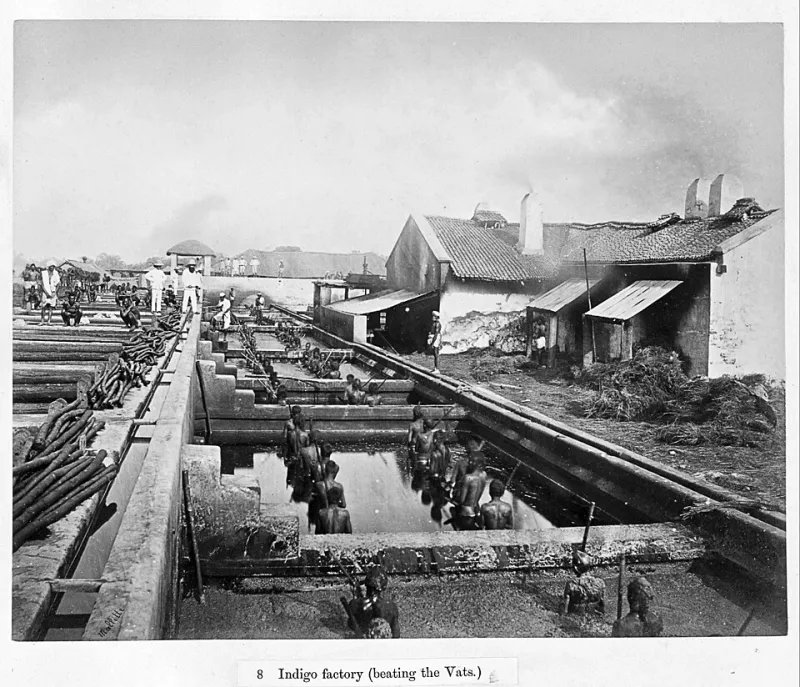
Photo: Oscar Mallitte, Public domain, via Wikimedia Commons
The thermometer on the wall of Marguerite Ellison's Gowanus studio read 51 degrees Fahrenheit when the vat began to complain. Not dramatically — indigo rarely announces anything — but the surface, which should have carried a coppery bloom of blue-green flower, had gone dull and quiet. Somewhere beneath the surface, the fermentation that gives aizome its life was slowing to a crawl.
Ellison had spent nearly two thousand dollars importing fermented sukumo — the composted leaves of Persicaria tinctoria — from a family processor in Tokushima Prefecture, the Awa region whose indigo has colored Japanese cloth for centuries. She had built the vat in October, following instructions from a Japanese dyer she had met at a craft symposium in Kyoto. By January, she understood the thing no manual had told her: a sukumo vat is not a supply. It is an animal.
The Blue That Was Never Meant to Be Consistent
American studios run on reproducibility. A paint lot number, a Pantone chip, a dye recipe scaled across ten yards of fabric — the assumption is that color, once achieved, can be repeated on demand. Aizome rejects this at the root.
The traditional Japanese reduction vat, or hakodate, relies on a colony of anaerobic bacteria feeding on wheat bran and the sugars within the sukumo itself. The bacteria reduce insoluble indigotin into a soluble form; cloth dipped into the vat emerges a pale, unremarkable green, and only oxygen — the air of the workshop — turns it blue before your eyes. Every dip depends on the mood of an invisible ecosystem: its temperature, its pH, its appetite.
Ellison describes her first successful dip as "watching a photograph develop in reverse." The green cloth oxidized into a blue so deep it seemed to have weight. Then she tried to repeat it the next morning and got a weak, watery sky instead. The bacteria had been fed too much. The vat was sulking.
What Tokushima Knows That Brooklyn Is Still Learning
In Tokushima, sukumo production is a two-hundred-day process of turning, watering, and composting indigo leaves, timed to the mountain climate. Master dyers there read a vat the way a farmer reads weather — by smell, by the sound of the surface when stirred, by the hue of the flower. There is no batch number because there is no batch. There is a relationship, renewed daily.
That relationship is exactly what a growing circle of American textile artists and painters is chasing. They arrive disillusioned with synthetic indigo's flatness and with natural dye kits that promise results without demanding attention. The fermented vat offers something the market cannot: a color that carries the conditions of its making. A winter-dipped cloth is not the same blue as a summer-dipped one, and to practitioners of aizome, that is not a flaw. It is the entire point.
Ellison learned this the hard way. During a February cold snap, with her Gowanus radiator failing, she wrapped the vat in an electric blanket set to low — a heresy she confessed to her Tokushima mentor over email. His reply was brief: "The blanket is fine. The impatience is the problem."
Slowing Down as a Technical Requirement
What began as a practical accommodation became, for Ellison, a philosophical shift. Keeping a vat alive through a New England winter meant visiting it daily, adjusting its feeding, warming it, listening to it. She stopped planning dye sessions a week out and started planning them a day out, contingent on the vat's condition. Her production schedule collapsed. Her work, she says, improved immediately.
This is the quiet argument aizome makes to American makers: that the pursuit of consistency may be the very thing flattening their color. The Japanese tradition does not ask the dyer to conquer the material but to keep it alive, and to accept that a living collaborator will never perform identically twice.
In April, when the vat finally steadied, Ellison pulled out a length of cotton she had dipped in January and one from the recovering vat in spring. Side by side, the two blues were unmistakably different — one cold and shadowed, one warm and luminous. She has stopped trying to reconcile them.
"I used to think I was dyeing fabric," she says. "Now I think I'm keeping something alive, and occasionally it lets me borrow its color."