Before the Gift, the Knot: What Mizuhiki Is Teaching American Paper Artists About Meaning
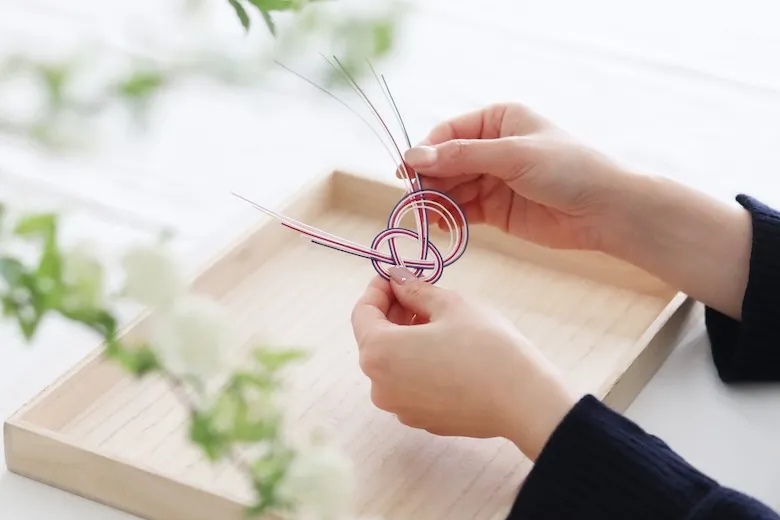
Photo: mizuhiki knot colorful paper cord Japanese gift wrapping close-up, via images.microcms-assets.io
Walk into any American gift shop during the holidays and you will see the aftermath of a culture in a hurry: rolls of printed paper, plastic tape, adhesive bows peeled off in two seconds and thrown away before the coffee is poured. The wrapping is a shell, discarded the moment the real gift appears.
In Japan, the wrapping has never been disposable in that sense. And nowhere is that clearer than in mizuhiki — the slender, often vividly colored cords, made from washi paper twisted and stiffened, that are tied around gifts, envelopes, and formal presentations. A mizuhiki knot is not decoration. It is grammar. It says who is giving, to whom, for what occasion, and how sincerely — before a single word is read.
A Cord With a Vocabulary
Mizuhiki traces its roots to the Heian period, when cords were used to bind official documents and offerings. Over centuries, the practice settled into a precise social code. Red and white cords announce celebration. Black, white, and a muted silver-gray accompany condolence. Gold and silver signal formal gratitude. Even the knot itself communicates: a bow knot (musubi-kiri), which can be untied and retied, is reserved for occasions you would happily welcome again — a birth, a promotion, a return to health. A knot tied so tightly it can never be undone is reserved for weddings and funerals, moments meant to happen once.
Consider the weight of that. An American wedding invitation might include a card, an envelope, perhaps a belly band. A formal Japanese gift enclosure tied with a firm mizuhiki knot is making an argument: this bond, like this knot, will not come undone. The object performs the promise.
"When I explain the musubi-kiri to American clients, there's usually a pause," says a Portland-based stationer who began incorporating mizuhiki into her wedding suites three years ago. "They realize they've never had a piece of paper mean something before. The knot isn't pretty. It's a vow."
The American Adaptation
Mizuhiki has been drifting westward for years — first through craft circles and origami communities, then through the wedding industry, where its clean lines and saturated colors photograph beautifully. Etsy listings for mizuhiki cord bundles have multiplied; specialty paper suppliers now stock imported cords alongside domestic alternatives.
But the more interesting story is not the aesthetic adoption. It is the small number of American makers who are learning the rules before breaking them.
In Brooklyn, a paper artist who designs keepsake envelopes for milestone occasions now consults a color chart before every commission. In Chicago, a wedding planner offers couples the choice between a retieable bow and a permanent knot — and finds that most, once they understand the distinction, choose the permanent one. "Nobody wants a marriage that can be untied," she notes. "That's not a design decision. That's a philosophy of the relationship."
These makers are doing something more deliberate than borrowing a look. They are importing a semantic system — and, inevitably, adapting it. Some blend Japanese color conventions with American palettes. Others use the cord to replace ribbon entirely, reducing waste while increasing meaning. The best of them resist the temptation to treat mizuhiki as a free-floating style, the way earlier generations of American design borrowed kanji tattoos without understanding the characters.
What a Throwaway Culture Might Learn
The deeper lesson of mizuhiki is not about cord at all. It is about intentionality — the idea that every layer of a gift is part of the gift.
Japan has long traditions of elevated wrapping: furoshiki cloths that return to the giver to be used again, layered washi papers, boxes designed to be kept. Mizuhiki sits within that continuum. The American gift economy, by contrast, generates staggering waste — estimates suggest holiday wrapping paper alone accounts for millions of tons of landfill each year, much of it unrecyclable.
A knotted cord offers a modest but genuine alternative. It requires no tape, no bow, no plastic. It can be untied and saved. And because it demands a few minutes of handwork, it forces a pause — the same pause that Japanese craft philosophy has always located at the center of making. You cannot knot a cord absentmindedly. The hands slow down. The intention catches up.
There is also something quietly countercultural in a tradition that values the container as much as the contents. American consumer culture treats packaging as an obstacle between buyer and product, something to be shredded. Mizuhiki insists the opposite: the presentation is the first sentence of the message. To receive a gift tied in a careful knot is to be told that someone thought about you before you opened anything.
Keeping the Meaning Intact
There is a risk, of course, that mizuhiki becomes another aesthetic extracted from context — the fate that has met so many Japanese craft traditions in the West. The color codes and knot types exist because a society agreed, over centuries, on what they mean. An American maker who ties a red-and-white cord to a sympathy gift has not merely made a fashion error; they have misspoken in someone else's language.
The artisans adapting the craft thoughtfully understand this. They study. They ask. They credit the tradition rather than claiming to have discovered it. And in doing so, they demonstrate something the original tradition has always embodied: that craft is not just skill, but respect made visible.
A knot, after all, is a promise made with the hands. It seems fitting that the Americans learning to tie it are also learning what the promise is for.