Kodawari, Misused: A Field Guide to the Japanese Words American Studios Can't Stop Borrowing
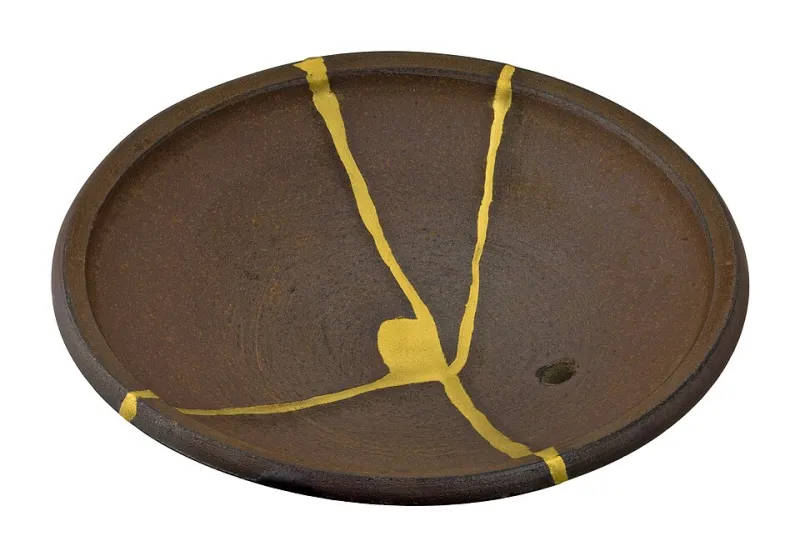
Photo: D-Kuru, CC BY-SA 4.0, via Wikimedia Commons
Somewhere in America right now, a design agency is pitching a rebrand built around "kintsugi" — the golden repair of broken pottery. Somewhere else, a startup is describing its onboarding flow as "shibui." The words are everywhere: in portfolio sites, in conference keynotes, in the mission statements of companies that have never touched a brush or a chisel.
Borrowing is nothing new; English has always looted other languages for exactly this kind of precision. But when a word carries a philosophy, translating it carelessly does real damage. To understand what gets lost — and what genuinely transfers — we spoke with Japanese-born designers and makers who have spent years working on both sides of the Pacific.
Kintsugi: Philosophy or Craft Project?
Start with the most famous export. Kintsugi — repairing broken ceramics with lacquer dusted in gold — has become American shorthand for "celebrating flaws." Mugs repaired with gold epoxy sell in museum gift shops. Corporate keynotes use the word to mean resilience.
Kyoto-born ceramicist Haruki Tanabe, now based in Brooklyn, offers a correction. "Kintsugi is not a metaphor that was invented. It is a technique that became a philosophy," he says. "The gold is not decoration. It records the history of the object. When Americans say 'embrace your flaws,' I understand the feeling. But kintsugi is slower than that. It says: the break happened, and now it is part of the object's story, and we will not pretend otherwise."
The distinction matters. Kintsugi is less about self-help and more about honesty — about refusing to hide what actually occurred. A repaired bowl with gold seams does not say "flaws are beautiful." It says "this happened, and the bowl continues."
Shibui: The Word Most Often Wrong
If kintsugi gets sentimentalized, shibui gets flattened. American usage tends to render it as "minimalist" or "understated elegance," which is rather like translating a haiku as "a short poem."
Shibui (with its noun form, shibumi) describes a beauty that reveals itself slowly — an object that seems plain at first and grows more interesting the longer you live with it. Tokyo-trained product designer Aya Mori, who works with clients in San Francisco, puts it this way: "Shibui is not simple. Simple is a starting point. Shibui is what remains after you remove everything that was trying too hard. There is depth hidden in it. A truly shibui object is not trying to be liked quickly."
Mori's test for clients: if a design's appeal is exhausted in the first glance, it may be minimal, but it is not shibui.
Yūgen: The Hard One
Then there is yūgen — the word most resistant to import, and therefore the most often abandoned halfway. Classical Japanese criticism used it to describe a profound, mysterious beauty in Noh theater and poetry: the sense of a depth beyond what can be seen, a beauty in what is only suggested.
American creative work tends to reach for it when describing fog, shadow, or moody photography. But yūgen is not an aesthetic filter. It is an experience of the ungraspable — the feeling you have looking at mountains behind mountains. "You cannot design yūgen directly," Mori cautions. "You can only leave a door open for it. If the work explains itself, the door is closed."
Kodawari: The Word Worth Stealing
The term these designers wish Americans understood better is one that rarely appears on mood boards: kodawari. It means a consuming, personal devotion to detail — an almost stubborn insistence on getting something right even when no one will notice.
"Kodawari is the sushi chef who seasons the rice for the fish that comes in an hour from now," Tanabe says. "It is not 'attention to detail' as a bullet point on a resume. It costs the maker something. It is love expressed as stubbornness."
Unlike the others, kodawari translates cleanly into creative practice. It is a verb disguised as a noun: revise the sentence no client will ever praise, tune the bridge of the song where only other players will hear the flaw, sand the inside of the drawer nobody sees.
A Working Vocabulary
Used carefully, these words earn their place in the American creative lexicon — not as decoration, but as disciplines:
- Kintsugi — repair that acknowledges history rather than erasing it.
- Shibui — beauty that deepens with familiarity, not novelty.
- Yūgen — depth suggested rather than shown.
- Kodawari — devotion to detail that no one is watching.
The pattern connecting them is instructive: none describes a style. All describe a relationship — between maker and material, viewer and object, present and past. That is what the buzzword versions miss. A word like shibui cannot be applied to a brand deck the way a font is applied to a headline. It can only be practiced, slowly, by someone willing to remove one more thing than feels comfortable.
The Japanese language did not give American creatives a palette. It gave them a set of questions. The studios that treat them as questions make better work. The ones that treat them as adjectives are, in the end, translating without understanding — and it shows.