Emptiness Speaks: Learning to Leave Room in an Age of Excess
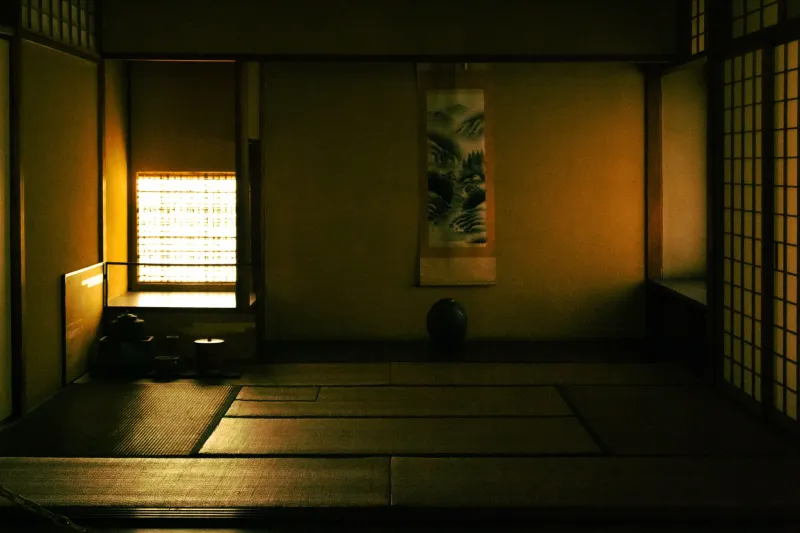
Walk into a traditional Japanese tea room and the first thing you notice is not what is there, but what isn't. A single scroll on the wall. One flower in a vase. Tatami mats stretching toward a corner that holds nothing at all. To Western eyes trained on abundance, the room can feel unfinished. In Japan, it is complete precisely because of what has been withheld.
That withholding has a name: ma (間), the interval, the gap, the pregnant pause. And for American creators working in a culture that treats more as a virtue, ma may be the most radical idea worth importing.
The Space Between
Ma is often translated as "negative space," but the phrase undersells it. In Japanese aesthetics, the interval is not absence — it is presence of a different kind. The silence between notes in a shakuhachi melody is not waiting to be filled; it is part of the music. The unpainted stretch of a sumi-e ink painting is not an omission; it is the mist, the river, the sky.
Composer Toru Takemitsu built entire works around this principle, letting Western orchestras breathe in ways their conventions rarely permitted. His silence was not empty. It was loaded, attentive, alive.
What American Creators Do With Silence
Contrast that with the default settings of American creative culture. The album that runs eighteen tracks because streaming economics reward runtime. The website with eleven calls to action above the fold. The film that cannot trust its audience without a score cueing every emotion.
Yet the most enduring American work often bends toward ma, whether the makers name it or not. Consider Bill Evans's spare piano voicings on "Peace Piece" — a recording that achieves its power through restraint, each note given room to decay fully before the next arrives. Consider the architecture of Luis Barragán's American admirers, or the plainspoken prose of a Raymond Carver story, where what a character refuses to say does the heavy lifting.
Restraint, it turns out, is not un-American. It is simply unfashionable in an attention economy that monetizes every unfilled second.
Practicing Subtraction
How does a creator actually work with ma? A few disciplines drawn from Japanese practice translate remarkably well to American studios and stages:
- Design the gap first. In traditional architecture, the tokonoma alcove is planned as emptiness before anything is placed in it. Try sketching what your song, page, or room will leave out before deciding what goes in.
- Let one element carry the weight. The tea room's single scroll works because it is single. If everything in your composition is emphasized, nothing is.
- Trust the audience's imagination. Kintsugi aside, Japanese craft rarely explains itself. The viewer completes the work. American creators routinely over-explain; the ending that resolves every question often resolves nothing.
- Edit toward silence. Record your track, then remove the layer you are least sure about. Rearrange the layout, then delete the least necessary element. If the work survives, the gap was doing its job.
The Courage to Stop
There is a reason this is difficult. Emptiness exposes. A sparse arrangement reveals every flaw in the notes that remain. A minimalist layout leaves nowhere for weak content to hide. Ma demands confidence — the maker must believe the work is enough.
That confidence is, perhaps, the deeper lesson. Japanese aesthetics does not treat restraint as deprivation but as generosity: room given to the viewer, the listener, the reader to participate. In a media landscape saturated with noise, the creator who leaves space is not saying less. They are inviting more.
The next time a project feels crowded, consider the tea room. Consider the pause. Consider what might happen if, instead of adding one more thing, you had the nerve to take one away.